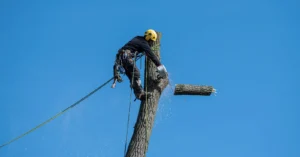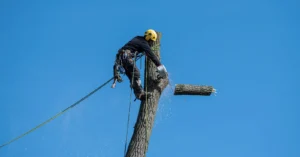
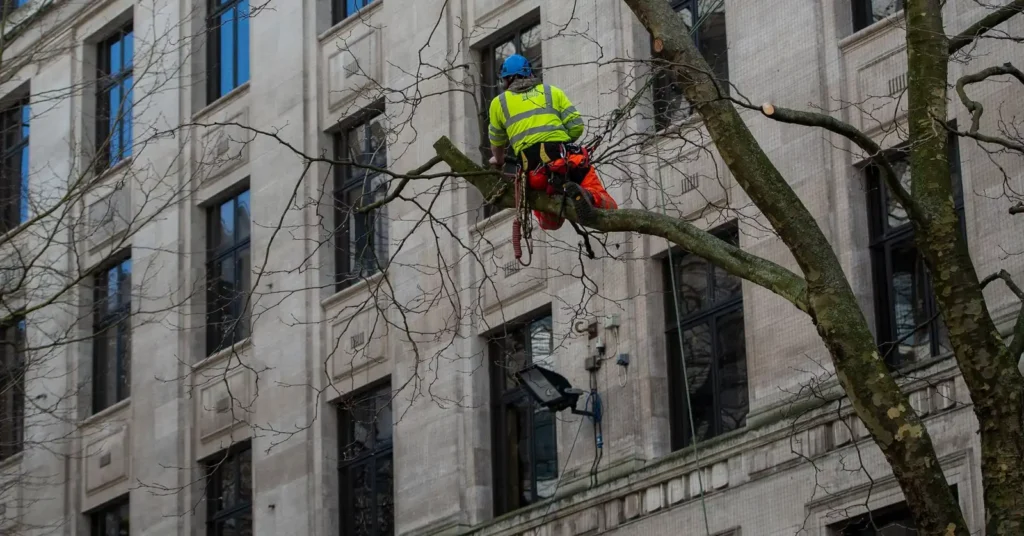
Felling means cutting a tree down. Removal means felling it and then taking the whole thing away, stump, roots (if agreed) and all the timber and brash, so your garden is left clear. In a lot of Dublin gardens you actually need removal, not just felling, because there’s nowhere to leave a dropped tree and nowhere for a homeowner to store two tonnes of logs.
We get asked this a lot, usually by someone who’s rung around for quotes and noticed the price for “felling” from one place is a fraction of the “removal” price from another. It’s not that one crowd is cheaper, it’s that they’re quoting for two different jobs. Worth sorting out before you compare prices, because you could end up with a felled tree lying across your lawn and a separate bill to have it taken away.
What tree felling actually involves
Felling is the cutting operation itself. On an open site, a straightforward fell means dropping the whole tree in one go, or in sections if there’s any risk to a shed, fence, or a neighbour’s property. That’s it. The timber, the brash, the stump, all of it stays on site unless you’ve specifically agreed otherwise.
This suits sites with space, like a large rural plot, a field boundary, or a big back garden where the owner wants the firewood or is happy to deal with clearing it themselves. It’s rarer in built-up parts of Dublin simply because there isn’t the room. A fully grown sycamore or ash dropped whole would do serious damage to a patio, a shed roof, or the neighbour’s fence in most back gardens from Rathmines to Swords.
What tree removal actually involves
Removal is the whole job from start to finish: felling (usually in sections for anything over a certain size or in a tight garden), lowering each piece down with ropes where there’s no room to drop it, chipping the brash on site, cutting the trunk into manageable lengths, and hauling everything out, often by hand through a side gate or even through the house if that’s the only access. Stump grinding is usually a separate line item, worth asking about specifically, and so is whether you want the logs left for firewood or taken away.
For most semi-detached and terraced properties across Dublin, this is the service people actually need, even if they start out asking for “a tree felled”. You can read more about how we approach this on our tree removal and tree felling pages, but the short version is: if you want your garden usable again afterwards, you need removal, not just felling.
The mistake we see most often
Homeowners assume “cutting the tree down” is the end of the job. It isn’t. A felled tree left in sections is still a huge amount of material, and green timber is heavy, far heavier than people expect. A single mature trunk section can weigh more than most people can lift, and a back garden full of brash takes hours to chip and bag even with the right kit.
We also see people underestimate access. Dublin’s older housing stock, think Victorian terraces around Drumcondra and Rathmines, or the narrower plots in Glasnevin, often has a side passage barely wide enough for a wheelbarrow. If the tree is in the back garden, everything has to come out that way, by hand, piece by piece. That changes how a job is priced and how long it takes, and it’s exactly the kind of detail that should be discussed before work starts, not discovered halfway through.
Do you need a permission before any of this?
Possibly. Many Dublin properties, particularly in conservation areas around Dun Laoghaire, Blackrock, Rathmines and parts of Dublin city, have trees covered by a Tree Preservation Order, or the tree may sit within a conservation area where felling rules apply even without an individual order. Some works to protected trees can still go ahead where there’s a genuine safety concern, but you need to establish that properly first rather than assume.
We won’t state the exact rules here because they can change and because every site is different, it genuinely depends on the specific tree and address. Before any felling or removal work on a tree you’re unsure about, check directly with your local authority’s planning department. If you’re not sure how to find out, ask us when you contact us for a quote and we’ll point you in the right direction based on what we see on site.
Felling or removal: what decides it
A few straightforward questions usually settle which job you actually need:
- Is there room on site to drop the tree and leave it? If yes, felling alone might be enough. If the garden is small or overlooked by fences, sheds or a neighbour’s boundary, you need removal.
- Do you want to keep the timber for firewood? Some homeowners do, and that can reduce the final cost since there’s less to haul away. Most in urban Dublin gardens don’t have the storage for it.
- Is the stump a problem? A fell leaves the stump in the ground. If you want a lawn, patio, or driveway there afterwards, you’ll need stump grinding as part of the job.
- Is access tight? Narrow side passages, steps, or no vehicle access all push the job from “quick fell” towards a full, more labour-intensive removal.
- Is the tree dangerous or diseased? That changes the order of priority and sometimes the method, rather than the end result, which is still usually full removal.
What pushes the cost up or down
We won’t put a figure on this, every site is different and anyone who quotes a price without seeing the tree is guessing. But the things that move the number up or down are consistent: the height and girth of the tree, how close it is to a house, power line, shed, or boundary wall, whether a crane or specialist rigging is needed instead of straightforward rope work, how far the material has to be carried to a vehicle, whether stump grinding is included, and whether you want the wood removed or left for firewood. A small leaning birch in an open back garden in Swords is a different job to a mature beech wedged between two houses in Rathgar, even though both are “just a tree removal” on paper.
Our honest view
If your tree is dead, diseased, storm-damaged, or leaning towards a structure, don’t wait and don’t try to save money by doing it yourself. We’ve been called out plenty of times after a DIY attempt went wrong, usually a tree hung up in a neighbour’s hedge or a branch that’s split and is now resting dangerously on a roof. In over 25 years working across Dublin, from Stillorgan to Clontarf, the jobs that go wrong are almost always the ones someone tried to shortcut.
If the tree is healthy and you simply want it smaller or shaped differently, you might not need felling or removal at all. A crown reduction or pruning can solve a light or overshadowing problem without losing the tree, and it’s worth asking us to have a look before you commit to taking a tree down completely.
Dublin Tree Surgeon has been doing this work across the county for over 25 years, fully qualified and insured. If you’re not sure whether your tree needs felling, full removal, or just a tidy up, get in touch through our contact page and we’ll give you a straight answer and a proper quote based on your actual garden, not a guess over the phone.
Frequently Asked Questions
What’s the actual difference between tree felling and tree removal?
Felling is cutting the tree down, that’s the whole job finished. Removal includes felling plus taking away the trunk sections, brash, and usually arranging stump grinding, so the site is left clear afterwards. Most Dublin homeowners need the second one.
Do I need planning permission to remove a tree in Dublin?
It depends on whether the tree is covered by a Tree Preservation Order or sits within a conservation area. Rules and thresholds can change, so check directly with your local authority’s planning department before any work goes ahead, especially for mature or prominent trees.
Can I fell a small tree myself to save money?
You can for a genuinely small, open-grown tree with no risk to people, property, or power lines. Anything with real height, weight, or a lean towards a structure is best left to someone with the right ropes, chainsaw training, and insurance, because the margin for a serious accident is much smaller than people expect.
Does tree removal include stump grinding?
Not automatically, it’s usually quoted as a separate item. If you want the area clear for a lawn, patio, or planting afterwards, mention this when you’re getting your quote so it’s included from the start rather than added on later.
What happens to the wood and brash after removal?
Most of it gets chipped on site and taken away, unless you’d like the trunk sections left behind as firewood, which can suit anyone with a stove and the space to store it. Just let us know your preference before the job starts.
How quickly can a dangerous or storm-damaged tree be dealt with?
Genuinely dangerous trees, ones leaning on a roof, split after a storm, or at risk of falling onto a path or road, should be treated as urgent. Get in touch as soon as you notice the problem rather than waiting, particularly during Dublin’s wetter, windier months when root and limb failure becomes more common.